
Most standard humidifiers cannot safely be used as a diffuser. Adding essential oils directly to a regular humidifier's water tank can damage the machine, grow mold, and even void your warranty. However, some humidifiers are specially designed with a separate oil tray or aroma pad — and those can safely double as a diffuser.
At first glance, they look almost exactly the same — both sit on your nightstand, both produce a misty vapor. So it’s totally natural to wonder if they do the same job. But they don’t.
Here’s the simplest way to think about it:
Feature
Humidifier
Diffuser
Primary Purpose
Add moisture to air
Spread essential oil aroma
Water Tank Size
Large (1–6 liters)
Small (100–500 ml)
Covers Room Size
Large (up to 500+ sq ft)
Small (50–150 sq ft)
Works with Essential Oils?
Usually No
Yes
Increases Humidity?
Yes — significantly
Very slightly
Good for dry air relief?
Yes
No
Good for aromatherapy?
No
Yes
Not all humidifiers are built the same. The type of humidifier you have matters a lot when it comes to essential oils. Here’s a breakdown:
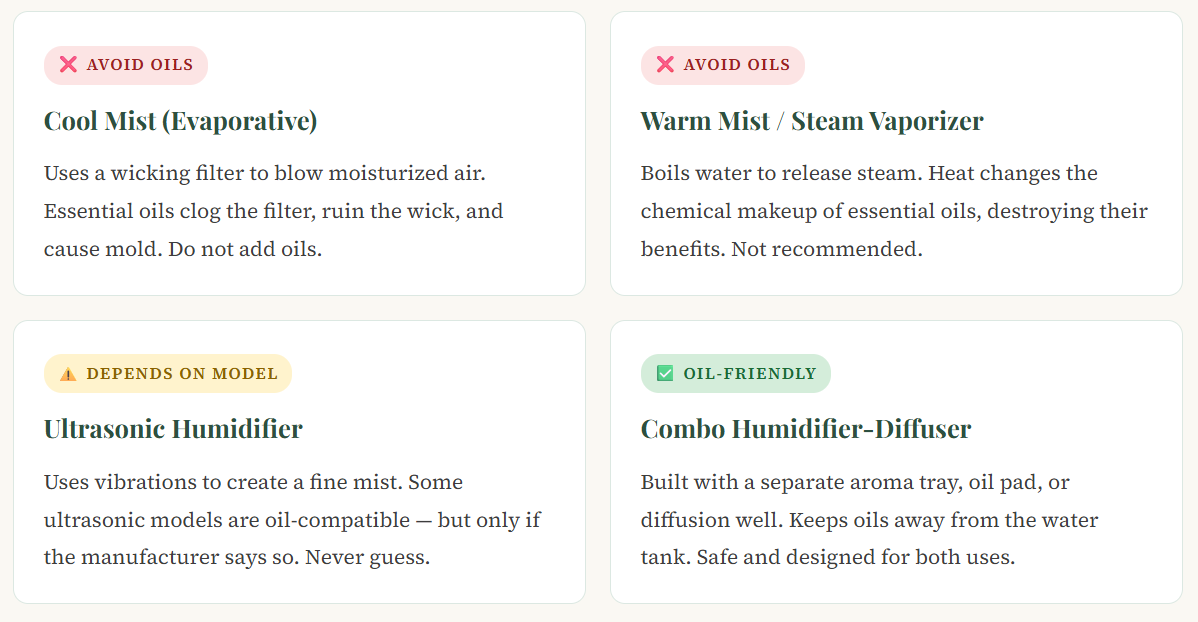
You might have seen someone online drop lavender oil into their humidifier. It smells nice — at first. But here’s what’s actually happening behind the scenes:
In a home experiment comparing a humidifier and an ultrasonic diffuser, a room starting at 22–23% humidity was tested for 30 minutes each. The humidifier raised humidity to 26%, while the diffuser only raised it to 24%. That means the humidifier was approximately 4 times more effective at adding moisture — but a diffuser simply cannot replace it for humidity control.
humidifiers built specifically to do both. The key is that they keep the essential oils completely separate from the water tank.
What to Look For
Still trying to decide if you need one, the other, or both? This table covers all the key differences you need to make a smart decision for your home.
Category
Humidifier
Diffuser
Main Job
Add moisture to air
Spread essential oil aroma
Water Tank Size
Winter & dry months
Year-round
Helps With
Dry skin, cracked lips, stuffy nose, sore throat, static
Stress, sleep, mood, relaxation, focus
Run Time
24–60 hours (large tank)
3–8 hours (small tank)
Room Coverage
Up to 500+ sq ft
Usually under 200 sq ft
Maintenance
Weekly cleaning, possible filter changes
Easy — rinse tank regularly
Noise Level
Quiet to very quiet (28–45 dB)
Near silent
If you’ve bought a humidifier that’s designed to work with essential oils, here’s how to use it the right way:
Make sure your model officially supports essential oils. Look for a separate aroma tray, oil pad, or diffusion well — not just the water tank.
Always fill the water tank with distilled or demineralized water. This prevents white dust (mineral deposits) from spreading around your room.
Never drop oils into the water tank. Put 3–10 drops of your chosen essential oil onto the aroma pad, tray, or diffusion well only.
Run the humidifier on a low mist level first to see how the scent disperses in your room before increasing intensity.
Empty and rinse the tank every day. Deep-clean the entire unit with white vinegar once a week to prevent mold, bacteria, and residue buildup.
If your model uses an aroma pad, replace it as directed — usually every 2–4 weeks — to keep the scent fresh and prevent buildup.
The ideal indoor humidity level is between 30% and 50%, according to the EPA. Use a cheap hygrometer (humidity meter) to monitor your room's level. Too much humidity (above 60%) can grow mold just as easily as dry air harms your health.
A standard humidifier is not a diffuser, and you can damage it by treating it like one. But you have smart options.
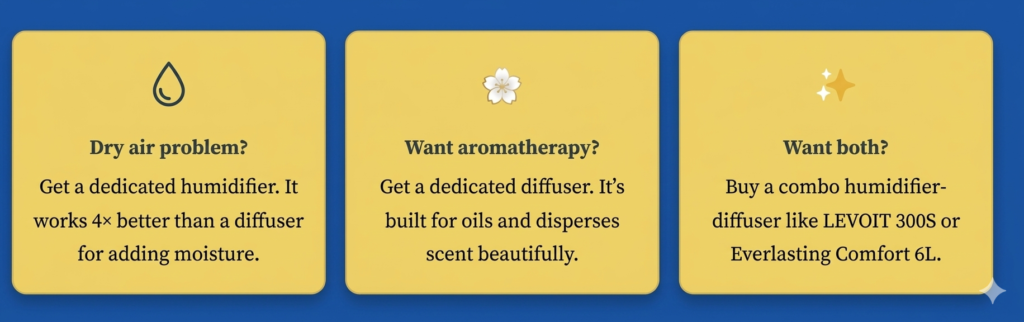
Not effectively. While ultrasonic diffusers do release a tiny amount of moisture, their water tanks are far too small (usually 100–500ml) to meaningfully raise the humidity in a room. In testing, a humidifier raised humidity about 4 times more than a diffuser in the same timeframe. If you have a dry air problem, a diffuser alone will not fix it.
Look for humidifiers with a built-in aroma tray, essential oil pad, or diffusion well. Popular options in the US include the LEVOIT Classic 300S (has a separate aroma box), the Everlasting Comfort 6L (has a built-in oil tray), and the ASAKUKI 500ml (designed as a combo unit from the start). Always confirm with the product listing or manual.
For most US homes, the LEVOIT Classic 300S is a top pick — it's smart (app-controlled), has a separate aroma box for oils, covers up to 500 sq ft, and runs quietly enough for a bedroom. The Everlasting Comfort 6L is another excellent option with a 50-hour runtime and a built-in oil tray. Both are widely available on Amazon.
Tayyabah Zahoor, a Physics graduate and skilled content writer, has built her expertise in reviewing home environment products. After creating in-depth guides on air purifiers, she has now expanded her focus to humidifiers. By applying her scientific background, she evaluates their performance, features, and benefits to help readers make confident and informed choices for healthier indoor air.